Amy Hodler works for Neo4j. Here’s her Linked in profile.
Neo4j specialise in graph analytics and the connections between data. I met Amy Hodler through the website Givitas (now defunct), which was all about giving help to others (rather than asking for help as such). Mostly inspired I think by Adam Grant’s givers and takers research.
Things we mentioned
We’re human. We cannot parallel process. Take the time to sharpen your own skills and give yourself a rest. There’s always more to learn. There are always things you don’t know.
I mention Givitas (now defunct), which is related to Adam Grant’s Givers and Takers research and Generosity Burnout. Here are some of the things Amy and I speak about.
- Amy Hodler’s background in Conflict resolution
- Why she took on projects she wasn’t quite ready for
- The worst thing you can do for your brain
- The all-important “to don’t” list
- What she looks for in a new recruit: Curiosity balanced with ability to concentrate, variety of things they’re interested in
- Why she asks potential recruits to describe a process
- Going beyond the problem the client thinks they have to the actual problem that needs solving
- We have a scarcity of good language to describe machine learning or AI so how do we get analogies and visuals to help flesh that out: e.g. the difficulties Amy had in explaining machine learning to her mother
- Amy’s Favourite Charity is a local community charity: the importance of making yourself available to help: the community finds you.
- How everybody “lies”. People don’t even know what they want.
- Why feedback and criticism is like training a dog
- Working ourselves “stupid”: Importance of sleep, The endless torrent of reading
Books and ideas Amy Hodler and I discuss
- The Information by James Gleick
- Black Swan the impact of the highly improbable by Nassim Nicholas Taleb
- Working on what you do well: the Strengthsfinder 2.0 and ViaStrengths will take you through a series of different questions to help you highlight your own strengths in the bigger picture. I prefer Strengthsfinder, it costs a little (just get your top 5). Viastrengths is more values than attributes, but you can get an initial report for free.
- Insight research and some practical things you can do to make your brain processes work for you.
- Why you should take notes by hand here and here
- I say in the podcast that negative feedback doesn’t work, and apparently I’m wrong, according to this study. But the same link will tell you that people ignore negative feedback 70% of the time, so in fact it is true that it’s a waste of our breath much of the time!
- Simon Sinek Start with Why, plus the video below
- Gretchen Rubin Happier at home plus the video below
Check out other podcasts from Women in Data Science in this series
- Elizabeth Moore
- Christina Igasto
- Browse all episodes here
Episode Transcript
Cindy Tonkin: My guest today is Amy Hodler. She’s coming to me through a quite a circuitous route by Givitas, a network I’ll include notes about on the show page. Amy, please tell me what you do so we can get some context.
Amy Hodler: I am the program manager for graph analytics and AI at Neo4j, a graph platform company. In essence, my work is about storing, computing, and analyzing connections between data. It’s all about the relationships between data points.
Cindy Tonkin: That’s great. I’d imagine that’s both time-consuming and a passion for you.
Amy Hodler: It’s fascinating. I got involved with Neo4j a few years ago because I became interested in studying information in general. I read a couple of books that changed the way I thought about data. One was The Information by James Gleick, which is about the history of information theory and how we started to categorize information. The other was The Black Swan, which is about the study of risk, particularly risks you don’t see coming. These books got me excited about information theory and complexity studies—how to study systems, whether they’re traffic patterns, the brain, or economics. When I started taking online courses, I realized that graph theory, which has a long history, is the mathematics used to study these networks. That led me into network science and eventually to Neo4j. It’s a fascinating area.
Cindy Tonkin: Absolutely. You could probably keep studying it for centuries because every new discovery teaches you something else. That’s beautiful.
Amy Hodler: It’s also an important area for people to consider today because the world is becoming so much more interconnected and interdependent. As soon as you have interconnections, whether you’re talking about banks, cybersecurity, fraud, or brain chemistry, you need to study the system as a whole. I believe network science and complexity science are crucial for the 21st century.
Cindy Tonkin: That’s excellent. What’s your background? What did you study to get to where you are today?
Amy Hodler: Interestingly, I didn’t study mathematics, although I have a love for it. I studied international studies in school and wanted to get into conflict resolution, which you could say has an element of complexity. After school, like many people, I needed to find work and ended up in call centers, helping people with their problems and trying to figure out the real issue behind their questions. I eventually worked at several technology companies and got closer to the analysis of the systems we were working on. As for how I got here, it was mostly through self-study and being tenacious about the projects I wanted to work on. One thing I always recommend to younger people in their careers is to take projects one step further and step outside of your comfort zone. It’s the best way to learn and to see if you’re truly interested in something.
Cindy Tonkin: Great advice. Tell me about your daily routines. How do you work smarter, and what do you do to stay fresh and informed? I know you read and study outside of your work. What else do you do?
Amy Hodler: One of the biggest things I’ve learned that has helped me the most is learning to schedule focus time and not multitask. I truly believe there’s no such thing as multitasking; you’re just task-switching, and you’re not as effective. Plenty of brain studies show that multitasking degrades your abilities considerably, and doing it over many years can actually lead to changes in the brain. I think multitasking is one of our worst modern habits. The easiest way to work smarter is to not multitask. It’s a difficult habit to break, but you can force yourself into a more focused environment by being present on a phone call, walking away from your desk to read something thoroughly, or even using paper to develop a presentation before you open a computer.
Cindy Tonkin: Excellent. You’ve been talking about lessons you’ve learned. Are there any particular lessons you wish someone had told you earlier or that you wish everyone else would remember?
Amy Hodler: Yes. We often focus on what we don’t feel we do well and try to bring that up to an average level of competency. But I actually think we should focus more on what we naturally do well and not worry so much about those other things. A perceived flaw or bad habit often has a positive correlation on the flip side. For example, if you tell someone to stop saying umm or ah during a presentation, they’ll focus on nothing but that and won’t be able to stop it anymore. Instead, you should tell them, “You’re great at X, just focus on that.” You’ll be better at what you do well, and you’ll find more long-term enjoyment if you’re not trying to be something else.
Cindy Tonkin: Exactly. A sundial in the shade is useless. We should find where the sun is and put people there because otherwise, we end up with a team of mediocre people. I remember a story about all the animals going to the same school, but the squirrels are hopeless at swimming, and the fish are terrible at climbing. So everybody fails. Instead, we should embrace that some people have a natural ability to do things others don’t. That strengths-based approach makes a big difference.
Amy Hodler: Yes. And I think that’s very different from what I remember in the workplace. The other thing is if you are an excitable, interested, and passionate person, you probably have too many things on your to-do list. You need to realize that you can do anything, but you can’t do everything at the same time. A good friend of mine has a “to-don’t list.” It’s a list of things she would like to do but has decided not to do this year. Every time a new idea comes up, she checks her “to-don’t list.”
Cindy Tonkin: Yes, that’s a great strategy. Do you recruit people? Do you have people working with you in your space at the moment?
Amy Hodler: I do. We are actively interviewing right now for data scientists and data engineering roles. We’re always looking for people to help round out the team.
Cindy Tonkin: So tell me, what qualities or attributes do you look for when you’re recruiting?
Amy Hodler: We have a very technical team that can vet the technical skills, so I don’t worry too much about that, with one exception: do they have skills that we don’t already have on the team? As humans, we have a tendency to gravitate toward people who are very much like us. You have to actively remind yourself to look for skills you’re not good at and probably never will be.
Cindy Tonkin: So you recruit to your weaknesses so you don’t have to do those things yourself.
Amy Hodler: Exactly. That makes the team stronger. The other thing I think is really important is the balance between curiosity and the ability to concentrate. I’ve worked with some truly brilliant people who are very curious about the world and can see things from different points of view. They are more innovative and creative, but a lot of the time, there’s a need to focus and concentrate on less interesting tasks. Data cleansing isn’t exciting, but everybody has to do it. So, having people who can balance curiosity with tenacity is essential. When I ask people about their curiosity, I ask them to describe different projects they’ve worked on and what they were excited about. You can hear it in their voice when they have a variety of experiences. To me, that’s a good indicator of curiosity and a willingness to pursue beyond the obvious. When I think about tenacity or concentration, I ask them to describe a less-exciting process in their jobs—maybe a technical model they had to build, how they prioritize features, or how they developed a messaging framework. It’s good to hear a candidate talk about that.
The Importance of Context and Perspective
Cindy Tonkin: So those are the things you recruit for. Are they also the things that make a better data person?
Amy Hodler: I believe so, because curiosity helps people look beyond the obvious, beyond what’s just on the surface. They can ask more probing questions. One thing that I’m not great at, but love when we get people on the team who are, is looking beyond the problem someone says they’re having. A customer might ask for a correlation between A and B, but the actual problem they have is different. A good data scientist is better at working with the customer to find out the actual problem they’re trying to solve. People don’t ask for what they need; they ask for what they think they need.
Cindy Tonkin: I have a story about that. When I set up this podcast, I bought two microphones and couldn’t plug them both into the single USB port on my computer. I went to the store and said, “Please give me a USB multi-port adapter.” I plugged it in, and it didn’t work. The adapter only worked for one device at a time. I hadn’t actually solved my problem because I went with the wrong diagnosis. My real problem was, “I need to record with two microphones,” not “I have one USB port, so I need an adapter.” But I described it that way, and I got the answer I thought I needed, which was wrong. It turned out the software only takes one microphone anyway, so it wouldn’t have mattered how many ports I had. Solving my own problem as a customer was not the right approach.
Amy Hodler: That’s a great example. Very technical people often fall into the trap of not probing beyond the specific question they’re presented with. A great data scientist thinks beyond what’s actually being asked.
Cindy Tonkin: It’s a talent required not just in data science but in most consulting roles: finding out what the problem really is, rather than just solving the one the client has already diagnosed.
Amy Hodler: Yes, exactly.
Cindy Tonkin: So, when you need to explain a complex idea to a client, how do you approach that?
Amy Hodler: There’s never just one answer. Abstractions are very helpful, and if you can relate the abstraction to a story or analogy that people can relate to, that’s even better. Visuals are also very helpful. I often find that the visuals I end up using come from an engineer’s phrase or a verbal analogy they used to explain something. It’s interesting to really listen to our technical folks and the language they use, and then you can move that into a visual.
Cindy Tonkin: Right. It’s like paying attention until you find a relatable phrase that gives them an insight into what the concept is.
Amy Hodler: Exactly. I think we have a scarcity of good language to describe artificial intelligence and machine learning right now. That’s part of the problem with the confusion and distrust of AI. When you use the word “intelligence,” people assume it has a mind of its own. Once you explain how it’s not magic, the next reaction is, “Oh, is that all it is?” As soon as it stops being magic, it’s no longer exciting. I look forward to getting over that hump, where it’s no longer magic but is still understood as being smart, if I could come up with a better word for it.
Cindy Tonkin: Do you have a better word for it?
Amy Hodler: I think the language will develop as people internalize more of the abilities of machine learning. A few weeks ago, I explained machine learning to my mother. She’s not in technology, but she watches the news and follows what’s going on. The idea of machine learning seemed like magic to her. I tried to explain it as “error reduction”—you’re really just trying to optimize for a number. At that point, it made a lot more sense to her that it wasn’t learning the way a child learns. Of course, her reaction was, “Oh, is that all it is?”
Cindy Tonkin: It’s like you say, when it’s mysterious, it’s magic. When you explain a magic trick, it’s no longer a trick. And yet, AI is and will continue to do some fabulous things to move us forward.
Amy Hodler: Yes. I’m excited about some areas that are adding more context to AI. If you think about intelligence, we all learn and make decisions based on a bigger context. A classic example is a child putting their hand on a hot stove. They don’t need to do it twice. They understand from the context—its height, the glow, the warmth—that all stoves are hot. They don’t have to test every single one. We are now trying to add more context to the decisions that software suggests. This seems to improve prediction rates. If you develop a model to make a prediction and then add in context, the early estimates are coming back that the prediction rates are much better.
Insights and Final Thoughts
Cindy Tonkin: You mentioned a particular thing you wanted to speak about. Was that about network science?
Amy Hodler: Yes. It was about why network science is so important. The fact that so many of our modern systems and lives are more connected means understanding and studying everything as a network rather than in isolation is extremely important.
Cindy Tonkin: Which is interconnected with your point that people have to understand the context of a problem, not just the solution. Learning the context makes a difference in your conversation.
Amy Hodler: That’s interesting. I hadn’t put it all together, but I think you’re right. It’s all about context and connections.
Cindy Tonkin: Yes. It’s also about a profound truth that sometimes we should neglect the context and just fix the immediate problem. The opposite is also true: we need lots of context. That ambiguity keeps us on our toes.
Amy Hodler: It keeps life interesting.
Cindy Tonkin: I always ask people what their favorite charity is. Is there a favorite charity you like?
Amy Hodler: I would say, as opposed to a single organization, I think for those who can, being involved in their local community is profoundly impactful. I live in a very rural area, so public services aren’t as speedy or well-funded as in large cities. In a smaller community, people really rely on each other for miscellaneous things you cannot imagine ahead of time.
Cindy Tonkin: Do you give your time to students who want to get into tech?
Amy Hodler: Yes. I would say I’m probably less scheduled about it and a little more sporadic, but the community finds you when you start talking to people. Not too long ago, I sat down with a group of young ladies in middle and high school who were looking to get into STEM careers. We were supposed to have lunch, but it turned into a two- to three-hour conversation about their concerns: what it’s like being a woman in tech, how to get into the industry, and how to know what your passion is when you’re 16. I don’t know how anybody makes that decision, but they were worried about these things. Making yourself available and offering yourself when asked is a great way to give back to your community.
Cindy Tonkin: When they identify the need and you can give easily. It comes back to the idea of givers and takers. It’s all going around and around. Is there anything else you’d like to say about the world of data and smart data people?
Amy Hodler: The last thing that comes to mind is just realizing that we’re human, even though we love data. Going back to multitasking, we cannot parallel process; we are humans, not machines. You also need to take time to sharpen your own skills. It’s like using a kitchen knife and never sharpening it. At some point, it will either be of no use or you’ll cut yourself because it’s not sharp enough. Taking time to step back, sharpen yourself, and rest is important. People are very passionate, particularly in data science, but you also have to have fun and take time to sharpen yourself mentally, physically, and emotionally.
Cindy Tonkin: I’m having fun recording this. There are some very strong patterns. People are agreeing on a lot of things. It’s some data, and there are some correlations and interesting outlying things that are worth pursuing.
Amy Hodler: Tell me about the correlations. I’m curious.
Cindy Tonkin: Curiosity comes up every time. The type of curiosity people want differs, but everyone wants it. They want people who will say, “Hang on, I’ve been thinking about this from a different angle because I embroider or I climb trees, and that brings a different kind of solution to the problem.” So, depending on who it is, curiosity is a very common theme. Another one you mentioned, getting the context, also comes up constantly. When people are trained to be data scientists, it’s almost like they’re told, “Here’s the problem, go solve it.” But the real world is far more complex than a university assignment where you’re given all the pieces of information you need. The real world is like my story: “I want an adapter for my computer.” The customer has diagnosed their own problem, and you have to dig deeper.
This is good for me because what I do is teach people soft skills: how to ask questions, how to get along better with stakeholders, how to take a good brief, and how to say no while still sounding helpful. I’ve been working with data science teams since 2002. There are so many good data scientists out there who become so much better when they suddenly realize they can ask questions. It’s like a light comes on.
Amy Hodler: Do you think that’s a skill people come out of school lacking? We are a smaller company, and we’re looking at younger people who are usually just out of school. Is that a skill they aren’t getting?
Cindy Tonkin: I think it’s part of it. It’s probably a matter of experience. Some people are born with the ability to ask questions, but university assignments are often, “Here is the problem, go solve it,” rather than, “Go research this general area and come back with the problems that exist.” I think problem identification is missing. You need to find out what the problem is, not just solve the one you’re given. In the UK and now in Australia, there’s something called Data School where they give people—who may not be data scientists by profession—real-world assignments. It’s a one-year process. I think it’s not what they’re being asked to do in schools. Some people will naturally go, “Wait a second, what’s the problem you’re trying to solve?” but not everybody will. I don’t even know if the people who set the assignments in universities are aware of these problems.
Amy Hodler: I find that even when people tell you what a problem is, they will misinform you, not on purpose, but they will describe something different from the actual problem. I hate to say this, but you can’t even always believe them when they tell you, and that’s not natural for me. I have a tendency to believe everyone is telling me the absolute, honest truth, so I have to keep reminding myself that you can’t always take what they say at face value.
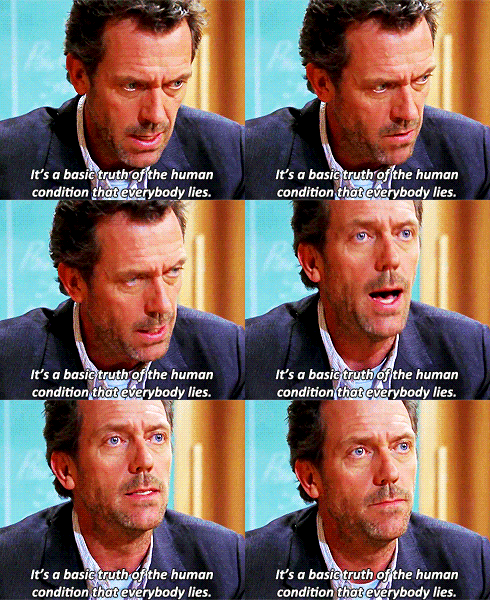
Cindy Tonkin: It’s a Dr. House thing. He says everybody lies. We’re not mean or horrible; we just represent our part of reality, which is blind to a large part of the problem.
Amy Hodler: I love that example.
Cindy Tonkin: I went into the store and said, “I want a USB adapter.” They gave it to me, and $24 later, I had a useless device. I wasted money because my identified problem was not the real problem. In the end, the software only allowed one microphone anyway, so it wouldn’t have mattered. I mean it’s a microcosm for everything. People don’t even know what problem they’re solving.
Amy Hodler: So how did you get involved in this line of work since it’s not something you studied in school?
Cindy Tonkin: I was doing soft skills work—influence and persuasion—in the early nineties. I had been a consultant for a while and felt that I wasn’t treating my clients kindly. I was in productivity consulting, teaching people how to do more with less, but we were just “jamming change down people’s throats.” I wanted to find out how to introduce change more swiftly while being kinder, and how to get people to adapt and embrace change rather than getting sick or stressed. Then, in the early 2000s, someone I’d worked with years before said I should come work with her at a major bank, and she happened to be in the insights and analytics area. Once you have one set of insights and analytics people talking to you, they move on and say, “You should come work with us.” So it was an accident of history, but the quest to find out how to do this better and smarter has been a lifelong pursuit.
Amy Hodler: Are you familiar with Simon Sinek and his Start With Why concept?
Cindy Tonkin: Yes. He simplified it, which is nice because it’s good to have a single answer.
Amy Hodler: I know. I can see that thread in what you’re talking about.
Cindy Tonkin: Absolutely. Giving me a “why” before I even know what a topic is makes a huge difference. “Why do I need to know what artificial intelligence is? What’s in it for me?” That makes a huge difference, because then people become interested. For people like you and me, we would just be curious and investigate it because it looks fun, but not everyone is like us.
Amy Hodler: I totally agree.
Cindy Tonkin: You get it. That’s why we’re even talking.
Amy Hodler: That’s fun. So what new projects do you have coming up?
Cindy Tonkin: I’m always looking for new client projects. This week, I’m doing an offsite for some people who maintain heritage buildings, which is very different from data science. I’m inventing a treasure hunt. It’s whatever the client wants, and right now, they want some team bonding. We’re doing a treasure hunt and some trivia while also dealing with topics like how to give feedback without killing people, what the difference is between feedback and criticism, and if people even hear criticism. That interpersonal team stuff is where I live, and at the moment, I’m obsessed with a treasure hunt.
Amy Hodler: That sounds fun. On the criticism part, do people even hear it?
Cindy Tonkin: Research seems to say that mostly they don’t. You’re better off pointing out what they’re doing right and asking them to do more of it than you are to point out what they’re doing wrong. I’m sure you’ve had the experience of knowing that if someone just told them, “Don’t do that,” everything would be okay. But the problem is they don’t hear it. If you say, “Don’t do something,” they pay attention to the negative action instead of what you want them to do. A lot of research shows we just waste our breath.
Amy Hodler: I hate to say this, but it’s like training a dog. If you pay attention when they’re doing something wrong, that’s what they’ll keep doing.
Cindy Tonkin: It’s like with babies, too. You have to give them attention for the right behaviors. We know this in one area of our lives, but we need to bring that into the workplace. Habits are hard to break. I still find myself wanting to say, “Don’t do that,” and I have to stop and ask, “What would I like them to do instead?” It’s an extra cognitive step that sometimes we’re too tired to take.
Amy Hodler: Thinking about being too tired, I have an exceptionally intelligent friend, an old coworker with a Ph.D. in math who now runs a VC firm. I used to do innovation labs for him. We would get smart people together, get them away from the office, and they would brainstorm new things. He would always say, “You guys work too hard.” I later realized he was saying, “You’re making yourselves stupid.” It’s a bit like my multitasking point. He was trying to get people to work less during the day to give their brains a chance to be creative because you can’t if you’re exhausted.
Cindy Tonkin: Exactly. All the research on insight says your brain comes up with an answer when you’re not thinking about the problem. You go take a shower or a run, and suddenly, you go, “Oh my God, now I know the answer!” We’ve all had that moment. I’ve also been reading about the need for hobbies or interests outside of data. It’s important to do something with your hands or go dancing—something that isn’t data all the time. In my own life, I paint, I sing, and I do improvisation. I know it brings me back to the topic at hand refreshed, whether it’s bringing information across from one domain to the other, I can’t really say because I’m always doing all these things. But I do know that executives I’ve worked with who have burned out often haven’t had time for hobbies and don’t even sleep enough. The research says the more sleep-deprived we are, the more we think we’re coping.
Amy Hodler: Oh, that’s interesting. I usually feel terrible when I’m sleep-deprived.
Cindy Tonkin: Me too. If I don’t get eight hours, I cannot function. But I have friends who regularly get five or six hours and tell me how incredibly on the ball they are. I’m concerned they’re not thinking straight.
Amy Hodler: I find it interesting—I don’t know if it’s the fear of missing out or the obsession with consuming information. I get sent so many links that my colleagues must be reading that I don’t know how they get anything done. They would have no time to concentrate. I’m a little puzzled by that. I occasionally get caught up thinking, “My reading list is so long.” Then I remember a writer I read who said he uses how long something has been around as a judgment of whether it’s worth reading. He meant that if he just heard about an invention last week, it’s probably not as important as a truth or book that came out five, twenty, or a hundred years ago that has withstood the test of time. I try to remember that. I don’t know how some people really consume the amount of information they appear to be consuming and get anything out of it.
Cindy Tonkin: And the key is “appear to be consuming.” Is it better to read one thing and digest it or read 50 things and not contextualize it? I don’t know the answer. I do a lot of skimming. If something seems useful, I put the link on my blog so I can find it later. I became a fan of listening to podcasts because I can get the important bits of an author’s book without having to read it. I’m skimming in a different way. But you’re right, I cannot read everything that comes into my inbox; I have to filter. A lot of what I do is put things on my blog so that I can find them later. It’s for me. When a client tells me, “I always type my notes, and I’m fabulous at it,” I can say, “Here’s some research, read this, and see what you think.”
Cindy Tonkin: Well, that sounds like a fabulous place to end, Amy. Thank you so much. Thank you.