Elizabeth Moore is on my podcast this week.
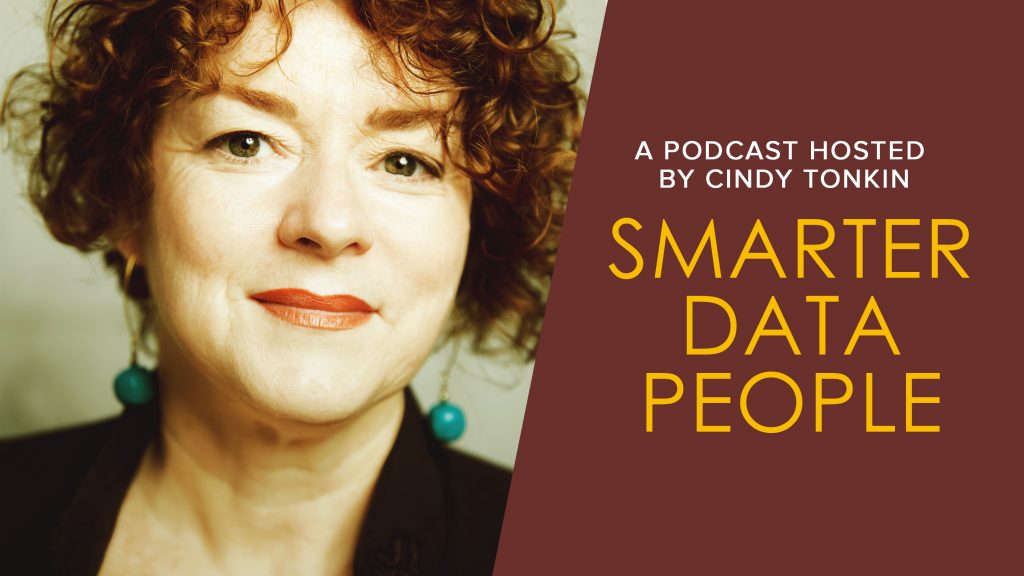
Elizabeth Moore is a world-class leader of Insights and Analytics teams in large corporations. I am honoured to have spent some time with her talking about what makes for smarter data people.
Liz speaks about:
- Working in a meeting-rich environment
- Her routine as a Senior Manager in a complex corporate environment
- Why data professionals get arrested in their careers (and how not to)
- The importance of fueling curiosity
- How the best relationships are forged in disaster
- How she keeps up with her professional development
- The importance of the meeting before the meeting
- Why she seeks “consulting” skills in insight professionals and is hiring ex-Strategy consultants because they have what it takes to get to the “next level” with insights
For more links see the podcast episode here.
Other podcast episodes you may enjoy:
- Sidney Minassian on Smarter Data People Podcast
- Signs you need Smarter Data People
- 66 Personal Development Habits For Smart People
- Get Smarter and Happier

Podcast Transcript for Liz Moore
Cindy Tonkin: Hi there, this is Cindy Tonkin. I’m the Consultants’ Consultant. I work with data science teams, helping them work even smarter, faster, and nicer. If you’re brilliant and you want to be even better, this is the podcast for you.
Hi there, this is Cindy Tonkin, and you’re listening to Smarter Data People. Today’s podcast features Elizabeth Moore, one of the most wonderful clients I’ve ever worked with. She’s going to talk about how some of the best relationships are forged in disaster, what it’s like to have an inbox with more than 70,000 unread emails, and where she thinks the next level is for most data insight professionals. Listen in.
I don’t know how to introduce Elizabeth Moore. She’s fabulous. I’ll write a better introduction for her when I’m not on the air and I’ve had time to think about it. Elizabeth Moore has been a friend and client since 2004, I think—14 years. We’ve lived through some trials and tribulations. She’s my favorite data person, a Smarter Data Person, and she’s on Smarter Data People.
Elizabeth Moore: It’s a pleasure to be here.
Cindy Tonkin: It’s a bit weird, I feel like I’m running a radio show. My first question, Liz: How do you work smarter? What’s your big thing?
Elizabeth Moore: It’s making sure you’re working on the right things.
Cindy Tonkin: Okay, how do you do that?
Elizabeth Moore: The smarter piece is that your analytics are only as good as the problem you’re trying to solve.
Cindy Tonkin: Right, okay, that’s a great point.
Elizabeth Moore: There’s your sound bite. We can be using the best math with the best data structure, doing the coolest things with robotics, AI, and machine learning, but if we’re not actually making a difference from either a business or social perspective, then it’s all a waste of time. What is the outcome of what you’re doing? Getting really crisp and clear about the business problem you’re trying to solve is key. Can you execute off the back of what you’re doing? For me, that’s how you work smarter, by getting focused on what you’re doing.
Cindy Tonkin: You’ve worked with hundreds of world-class data analysts across a whole gamut of industries. What makes a good one or a bad one?
Elizabeth Moore: I think there’s a certain technical baseline, a price of entry.
Cindy Tonkin: A price of entry?
Elizabeth Moore: Yes, your ticket to the dance. You’ve got to have a certain level of technical capability, but what makes the best ones is curiosity and an ability to build relationships with the business people who are going to use your output. Most analytics people don’t have a product or a channel to market; we rely on others. I’ve worked in large, complex organizations, and the stuff we do on its own doesn’t drive a business or a social outcome. It actually needs to link into other parts of the business.
The analysts who have made a significant difference are able to link cool, new analytic developments through to execution, whether that’s getting a product to market, getting a message to a customer, or making a business decision. They start with that outcome in mind rather than starting with a cool technical kit.
Cindy Tonkin: We don’t have a problem with a cool technical kit.
Elizabeth Moore: I love the cool technical kit.
Cindy Tonkin: Let’s get more of that.
Elizabeth Moore: Yes.
Cindy Tonkin: But that’s not the outcome the client needs.
Elizabeth Moore: It’s not the outcome the client needs, and you don’t get cool technical kit for the sake of having a cool technical kit. You don’t want a giant data lake for the sake of having a giant data lake.
Cindy Tonkin: I want a giant data lake.
Elizabeth Moore: I know.
Cindy Tonkin: Let’s go swimming.
Elizabeth Moore: Let’s go swimming across the data sea. The question is, what are you going to do with it? What is the outcome that you’re wanting to drive? You’re less likely to end up with a data white elephant if you’ve actually got some clear business use cases at the foundation of what you’ve architected, built, and ultimately activated.
Cindy Tonkin: Is that where people get stuck in their careers, when they come to a place where they can’t do that bit?
Elizabeth Moore: My experience is that people get stuck when they’re not able to clearly link into a business problem. The other aspect I find is the inability to communicate what you’ve done in a way that humans can understand. There’s a temptation to linearly explain every step of the analytic process, like a fairy tale where you have to explain every crumb leading to the gingerbread house. It would bore your stakeholder, when all they want to know is what the gingerbread house looks like.
Cindy Tonkin: We were talking about a metaphor we used a couple of years ago: When you go to a travel agent, they don’t say, “First you’re going to have to stand in line at customs. Then you’re going to…” Instead, they say, “It’s a beautiful beach. You’re going to love it, and you’re going to have all these wonderful things.” We want that.
Elizabeth Moore: That doesn’t mean you won’t run across a stakeholder who wants to know all that detail.
Cindy Tonkin: Where the breadcrumbs come from.
Elizabeth Moore: Yes. Where the breadcrumbs come from, what they’re made of, how big the breadcrumbs are, what the pathway looked like, what trees you walked past—there are going to be stakeholders who want to get down into that detail, and you’ve got to be prepared to answer those questions.
For the majority of stakeholders who are completely overwhelmed with information and things demanding their attention, anything you can do to cut through and clarify what they need to do with the insights you’ve generated is helpful.
For me, that switch from “I’m an analyst” to “I’m an insight professional” is where people get stuck. They assume that if someone doesn’t understand the math, they’re an idiot and they need to understand it. When you assume someone just needs to understand, you’ve lost them. You need to be able to explain the insight in a way that drives action, whether that’s business or social action, whatever industry you’re working in. In my industry, it’s usually about making a business decision, often in a marketing context, where we want to take an action that results in a better interaction with a customer.
Cindy Tonkin: Absolutely.
Elizabeth Moore: A better service interaction, or a better sales interaction, that results in the customer being better off because of using all this data and analytics. To do that, there are long, complex processes. In large organizations, you need to convince product people, channel people, and strategy people that all of these things need to come together to result in a different offer in-store or a different digital banner ad than what would have been there otherwise.
Cindy Tonkin: So you are constantly persuading, influencing, informing, and cajoling. I know you use a number of tools. The Enneagram is one of them. Are there other tools? Can you talk about how you use those?
Elizabeth Moore: Yes. It’s about consciously thinking about what type of stakeholder you’re dealing with, how they want to consume information, and where they’re coming from. I might use Enneagram types or Strengthfinders, thinking, “Actually, they have a strong learning function and I need to take them something really interesting.” Or they might be somebody who’s driven by innovation, and going to them and saying, “We’ve got this cool, new technique. Your product is special, gorgeous, and different, and we want to be first in the world at doing this,” is going to motivate them to buy into whatever project you’re trying to get off the ground.
It’s about crafting the message to how you think that individual is going to want to see it. It’s important to see each person as an individual who thinks and is motivated differently. Getting to know people is essential, almost like being an internal consulting team. You want to work with people that you like, honestly.
Cindy Tonkin: Don’t we all? Absolutely.
Elizabeth Moore: Get to know the people you’re working with and find what you can like about them, and what they can like about you. My experience with stakeholders is that the best relationships are often forged in disasters.
Cindy Tonkin: A few minutes in the trenches together and we’re happy forever.
Elizabeth Moore: The project that’s gone wrong, having to front up to a senior stakeholder steering committee and basically say…
Cindy Tonkin: “We don’t have the thing.”
Elizabeth Moore: “We don’t have the thing. It’s broken. It will never be.” Working together through those kinds of things is where you forge strong bonds.
Cindy Tonkin: So it’s not necessarily a bad thing to have a small disaster early on in a project?
Elizabeth Moore: No. I wouldn’t go out of my way to create a disaster, but you can use small setbacks in a project to bond with the other team members.
Cindy Tonkin: It’s not the end of the world to come back and say, “We’re behind schedule, and here’s what we’re going to do to fix it”?
Elizabeth Moore: Correct, and do it early and often. That’s another thing I find you have to work with early in your career. The tendency is to just sit there and work on the data. If something goes wrong, hunkering down and going to ground is never a good idea.
Cindy Tonkin: That’s what people want to do.
Elizabeth Moore: Yes. It’s what we all want to do. Nobody likes having to call someone and say, “It’s going to be late,” or, “I messed up,” or…
Cindy Tonkin: “We can’t do what we thought we were going to do.”
Elizabeth Moore: It just doesn’t work, and it happens all the time because the work is often experimental. You don’t know. A lot of the stuff that analytics teams are doing, particularly now, involves pushing the envelope on what technology and data can do. Sometimes stuff just doesn’t work. The data feed breaks, the data warehouse is down, or the data you thought was there last week is now somewhere else. That means the promise to deliver by Friday, you’re not going to make it.
As soon as you realize you’re going to miss that, pick up the phone, have an in-person conversation if you can—face-to-face if you can, or a phone call as a second choice. Don’t send an email saying, “I’m on the way.”
Cindy Tonkin: Or just a text and go away for the weekend.
Elizabeth Moore: It’s face-to-face, phone call, text, and then email. The reason I say that is that emails are just overwhelming, in my experience.
Cindy Tonkin: There are so many.
Elizabeth Moore: There are so many. From a work perspective, I’m dealing with 250 to 300 a day. I may be dealing with them in the middle of the night.
Cindy Tonkin: What about when meetings go wrong? Have you been in meetings like that? Are there stories you can share with the general public about meetings that have gone off the rails, or advice you can give about that? Why do they go off the rails? Can they be rescued?
Elizabeth Moore: Meetings often go off the rails because you haven’t prepared. In my experience, when I look back and reflect on why something failed, it’s because I hadn’t prepared properly. I either hadn’t gotten across the content in enough detail, or I hadn’t shored up or managed the social process effectively before the meeting happened.
Cindy Tonkin: Right.
Elizabeth Moore: There’s a classic example you and I have spoken about where we were working with someone who was trying to get a very large capital project funded. This is a mistake you often make early in your career: You assume you’re the smartest person in the room and can just walk in, tell this amazing story, put up your slides, and everyone will say, “I want one.”
It goes wrong when you haven’t thought about each of the stakeholders and seen them beforehand. If you’re going in and asking for something big, you want to make sure you’ve got most of the people in the room lined up and it’s just a formality. There are the meetings before the meetings, and I know that sounds time-consuming, but there are people who will be able to help you get your idea across. Going and saying, “I need your help with this meeting. This is what I’m trying to achieve. Can you give me some advice on the best way to do that?” will build a relationship and get you the support you need.
Cindy Tonkin: Build a relationship and get you data.
Elizabeth Moore: Build a relationship, get the data across, and get the project across. In big meetings where you’re trying to get a decision to go your way, it’s never going to happen in the way you expect.
Cindy Tonkin: That’s not where the decision is made.
Elizabeth Moore: No, it’s not in the room where it happens.
Cindy Tonkin: It’s not in the room where it happens. Thank you, Hamilton.
Elizabeth Moore: It’s not. If we could look our way through all relationships…
Cindy Tonkin: “I’m not going to lose my shot.”
Elizabeth Moore: “I’m not giving away my shot.” Then there are just presentations that have gone completely feral because you’ve fallen in love with the technique. You’ve fallen in love with the analytic process and have completely forgotten about what you are there to do, which is to drive a business outcome. I’ve done that.
I can think of times when people just don’t care. They mentally go to Fiji when you’re off on a flight of fancy, talking about the elegance of an awesome technique, and how you repurpose choice modeling to do something amazing. You think it’s brilliant, but no one cares. What they care about is what they’re going to do as a result of knowing this. If you think someone is going to care about the technique, you should meet with them before the big meeting.
Cindy Tonkin: Do that before the meeting.
Elizabeth Moore: Do the engagement before the meeting. Spend half an hour with them, get them across the technical details that you think they may need to support you in the meeting. The other thing is not telling the story.
Cindy Tonkin: If you don’t tell a story, you’ve got a problem.
Elizabeth Moore: Yes. We’ve been talking a lot about inverting the triangle. This probably doesn’t work as well on a podcast as it does on a whiteboard, but if you think about an inverted triangle, with the point down at the bottom, most analytic processes start broad and wide at the top, and then we funnel and funnel. We get to the point, and there’s the answer. There’s a real temptation for us to tell the story in parallel with the analytic process, which is broad and then pointed. You bore people senseless doing that. You lose them. They’re not interested. They don’t want to do a page turn on every crosstab you ran, every spreadsheet curve, or every pivot you looked at in your pivot table. We talk about inverting that triangle.
Cindy Tonkin: Starting with the answer?
Elizabeth Moore: Yes, starting with the answer and then providing the three or four, or a maximum of 12, backup pieces of data that support it.
Cindy Tonkin: You were telling me yesterday about some consulting teams you’ve seen who start with the answer and then find the data that goes behind it. What are your thoughts on that?
Elizabeth Moore: I think there’s a lot we can learn from the way they present information. When I think about what is seen as the gold standard for corporate storytelling in corporate Australia, it’s the big consulting firms and the way they approach telling a story and presenting it. The slides are so beautiful you’d want to lick them. They’re nicely designed.
Cindy Tonkin: They’ve got fat, salt, and sugar.
Elizabeth Moore: They do have fat, salt, and sugar, and they’ve got lots of white space. They’ve got a consistent font, the charts are labeled, and there are very rarely pie charts, which keeps Rusty happy. That’s the gold standard of strategy presentations. Senior stakeholders are used to seeing that as the gold standard. When you think about the quality of storytelling and analytic presentation that most analytic teams serve up to those stakeholders…
Cindy Tonkin: It looks like a poor cousin.
Elizabeth Moore: They’re worlds apart in visual presentation. While I’m not necessarily a fan of, “Here’s the answer, let’s go find data to support it,” I do think there’s a lot we can learn from those strategy houses about how to present a story in a way that is crisp and clear, and that draws business people to understand the insights and the action that needs to be taken. I’m not an advocate for starting with the answer and then finding data to support it.
Cindy Tonkin: You’re an advocate for high production values around the final presentation, so it seems as if you may have done that, even if you did it the right way?
Elizabeth Moore: I think it comes back to the language that stakeholders are used to engaging with around high-quality advice. That’s what they’re used to seeing. High-quality advice comes with those beautiful presentations that have the business insight at the top and then supporting data. I think we, as a profession, can learn a lot about not forcing our stakeholders to sit through the inverted pyramid with all the fat data at the top down to the bottom, waiting for an hour.
Cindy Tonkin: To get to the answer.
Elizabeth Moore: Or we may not even get to the answer in the meeting.
Cindy Tonkin: We don’t even do the “after the break, you’ll hear the three reasons why you should keep on listening to this podcast.”
Elizabeth Moore: Yes. I think there’s a lot we can learn from them. Too often we, as a profession, have said, “Oh, no, we’re not management consultants. They are a spawn of Satan, and they’re trying to cut our lunch and steal our work. I don’t get it.” But they are consistently engaged to provide high-level advice to boards and top levels.
Cindy Tonkin: They are getting it right on some level?
Elizabeth Moore: They are getting it right on some level. It’s like they’re smarter than us.
Cindy Tonkin: Often, they are just us three weeks later.
Elizabeth Moore: Yes, and they’re taking the analytics that we’ve done. So often, I hear from my team, “But that’s our work.” It’s like, well, it is to a point, but they are better at telling the story. The reason they were able to get traction and were employed in the first place is that we failed to tell the story in a way that engaged senior people to take the strategy decision that we knew needed to happen all along.
Cindy Tonkin: This is a skills gap, ultimately.
Elizabeth Moore: Yes, shame on us. It’s a skills gap, so we need to be very cognizant and allocate time and resources to telling stories. We should also shamelessly steal from the way strategy happens.
Cindy Tonkin: Yes. How do we copy the good bits and model what they’re doing well?
Elizabeth Moore: I’m hiring people who are ex-strategy consultants into the team because I think that’s what’s needed to take the function to the next level.
Cindy Tonkin: Because you can?
Elizabeth Moore: Well, because you can, but also because it’s a necessary skill. Smart analytics are a necessary but not sufficient condition to drive to action.
Cindy Tonkin: How do you keep your professional development going? What do you listen to and watch? Who do you pay attention to?
Elizabeth Moore: There are a couple of ways I do that. I rely on my partners—my external partners—like consulting firms, software companies, and market research people. There are probably four ways I ensure that I’m getting the professional development I need. It’s important to me because I have a high level of curiosity and I want to do interesting, innovative stuff.
I get one overseas trip a year, paid for by my company, where I get to go and visit a range of different software companies and peers around the world who are doing similar work, and we swap ideas. That’s really important to me. That’s a couple of ways of just having thinking time and innovation time. I try to mix it up by seeing people who work in my industry as well as people who work in adjacent industries and different analytics sectors. Then you end up with a nice global network of people you can call and ask, “Have you done this? Have you tried that?”
Another way is staying close to your partners—consulting firms, research houses, software vendors, and hardware vendors. They are often able to get out of Australia more than we are. I let them know the questions I want answers to.
Cindy Tonkin: What’s on your mind?
Elizabeth Moore: I’ll basically say, “Look, I’m interested in how you move from marketing and campaigns to marketing and customer journeys. What needs to evolve? Who’s done this best?” We set that question loose and they’ll come back with answers.
Cindy Tonkin: They want to please you and sell you more stuff.
Elizabeth Moore: They want to sell you more stuff, and it’s a way of adding value to an existing relationship. Staying close to that, and then following interesting people on Twitter or LinkedIn, seeing what they’re doing. I listen to a lot of stuff. I like to get out and go for long walks on the weekend, and I’ll have a lot of podcasts backed up. I love Adam Grant. I think we both have a professional crush on Adam Grant.
Cindy Tonkin: Yes, we love Adam Grant.
Elizabeth Moore: He’s awesome. Malcolm Gladwell. I really like Shane Parrish’s work, The Knowledge Project. I like reading his emails, but I really like listening to his long-form interviews. I think he’s a really great interviewer.
Cindy Tonkin: Fabulous.
Elizabeth Moore: He always has super interesting people on there. That then takes you down a rabbit hole. I like listening to Freakonomics.
Cindy Tonkin: Your background is economics. That was your first degree.
Elizabeth Moore: My first degree is economics, and I like that approach. I also like listening to sociology things. I listen to a lot of Slate podcasts. I really like The Waves, which used to be XX. It’s a number of women talking about what they’re reading, thinking, and seeing in society, and that sends me off on other things.
It’s not just data and analytics; it’s what’s happening in business, in academia, and more broadly. You can pick up stuff that is completely unrelated. Malcolm Gladwell has some really interesting things that make you think about what we’re doing differently. He’s such a good storyteller.
Cindy Tonkin: He’s fabulous. I love when he gets really excited and annoyed. “What I’m talking about here…” I love it.
Elizabeth Moore: The stuff he was doing on memory was really, really interesting.
Cindy Tonkin: The pilot thing. The pilot and the news, the journalist and… yes.
Elizabeth Moore: The journalist, and how that transitioned into supposed academic fraud when they were just errors because people were pulling data together. For me, it’s about thinking about how I use those little gems in what I do, whether that’s thinking about what that means for my research function. We’re often asking people to recall how they behaved.
Cindy Tonkin: How they liked that product. “When you first got this product, what did you do?”
Elizabeth Moore: “Last time when you were doing something, what did you do and what did you think?” There’s a lot of neuroscience and things like that that can be picked up and thought about in terms of how we approach our work. I often find myself going down podcast holes. You pick up one, you pick up Adam Grant, and then you’re led to or found Adam Grant via Malcolm Gladwell. I also like the NPR podcast, This American Life, and I also like How I Built This.
Cindy Tonkin: Oh yes, I think I’ve got How I Built This.
Elizabeth Moore: Yes, How I Built This.
Cindy Tonkin: It’s the series of entrepreneurs talking about their companies.
Cindy Tonkin: That’s the one where I listened to the Airbnb guy that I was talking about.
Elizabeth Moore: Yes, How I Built This. It’s an NPR one.
Cindy Tonkin: It’s fabulous.
Elizabeth Moore: It’s a guy from This American Life.
Cindy Tonkin: Have you ever seen How I Built This with Dyson?
Elizabeth Moore: I haven’t listened to that one.
Cindy Tonkin: Listen to Dyson.
Elizabeth Moore: Listen to Dyson. I like listening to the way people think. I’ll listen to Wil Anderson’s Wilosophy if he has guests I’m interested in, and that could be a musician, a writer, or somebody who’s working in refugee advocacy.
Cindy Tonkin: It’s not restricted in subject matter.
Elizabeth Moore: Yes, it fills my curiosity, and you need to have different points of view and different ways of thinking to bring a richer palette to your problem-solving.
Cindy Tonkin: Nice. I think that’s a perfect place to finish. Thank you for fueling my curiosity.